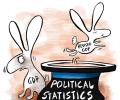
The Economic Survey 2022-23 (FY23), to be presented a day before Union Budget 2023-24 (FY24), is likely to project India's real gross domestic product (GDP) growth between 6 per cent and 7 per cent for FY24, Business Standard has learnt. The broader theme of the Survey could be on how India has dealt with two years of a global pandemic and the ongoing geopolitical disturbance, the strengths and weaknesses that emerged, and what lessons may be learnt. The much-awaited Survey will be the first one by Chief Economic Advisor V Anantha Nageswaran and his team in the finance ministry's economic division.
Crosses Budget Estimate by 5.5%, govt expected it to be 4.6% of GDP for current financial year

The tax collections are down by Rs 60,000 crore (Rs 600 billion) over budget estimates for 2008-09, Pranab Mukherjee said.

Brokers believe that the higher charges may not completely deter investors from taking bets in F&O but could help cool down some activity, as the threshold to break even rises.

The deficit stood over Rs 8 trillion in the first seven months of the current financial year. Non-tax revenues, comprising transfers from the RBI and dividends of the public sector units, shored up the Centre's revenues.

If the government cuts wasteful expenditure as it is trying now, the deficit would at most fall to 8 per cent, not less than that.

One waits to see where Munjya land though rest assured, a lifetime score of over Rs 50 crores is guaranteed from this point on.

'The Budget targets are achievable, but they require continued discipline and that the government sticks with the efforts to cut red tape and make business in India more efficient.'

Pakistan's outgoing government has acknowledged that it provided grants of Rs 687 billion to the powerful military for security-related spending that were in addition to the annual defence budgets.

Lower revenue collection puts upward pressure on government borrowing, ensuring that it deviates from the glided path of debt reduction

In this year's budget, Finance Minister Nirmala Sitharaman hiked tax on petrol and diesel, raised import duty on gold, levied additional surcharge on super rich and brought a tax on high value cash withdrawals as she sought to spur growth with reduction in corporate tax and sops to housing sector, startups and electric vehicles.

The company has the largest car park in EVs in India, estimated to be around 170,000 units. As a pilot, it has already started work with used online car marketplace Spinny.

This e-series funding round also makes OYO the most valued hospitality company in the country, ahead of the Tata group's Indian Hotels Company, which owns the Taj brand of hotels, and EIH, which owns the Oberoi brand of hotels.

'Nirmalaji's Budget announcements have long-term implications and are not backed by enough money when the short-term outlook looks bleak,' notes T N C Rajagopalan.

Govt may further hike excise on petrol, diesel before Budget.

The capital outlay for the three services, for modernisation, stood at Rs 78,586.68 crore

HDFC was the top gainer in the Sensex pack, climbing nearly 4 per cent, followed by PowerGrid, Sun Pharma, Tata Steel, Tech Mahindra and Bajaj Finserv. NSE Nifty surged 234.75 points to 17,401.65.

Revenue buoyancy of GST will be key to improve the resource position of both central and state governments.
The fiscal deficit touched 61.2 per cent of full year Budget Estimates or over Rs 3.24 lakh crore in end July.

The Reserve Bank's growth projection for next financial year is lower than 8-8.5 per cent projected by the finance ministry in the recent Economic Survey which was tabled in Parliament on January 31. Unveiling the bi-monthly policy, RBI governor Shaktikanta Das said, "Recovery in domestic economic activity is yet to be broad-based, as private consumption and contact-intensive services remain below pre-pandemic levels."

Neither films were rejected by the audience, something that has happened with so many recent, mid-budget films.
Budget-makers in North Block are looking to maintain this fiscal status quo, in spite of tax revenues nowhere close to where the government wants and in spite of possible higher expenditure commitments.

As India emerges from the COVID-19 crisis, the ninth budget under the Modi government, including an interim one, is widely expected to focus on boosting spending on job creation and rural development, generous allocations for development schemes, putting more money in the hands of the average taxpayer and easing rules to attract foreign investments.

Finance Minister Pranab Mukherjee was saddled with a number of handicaps when he presented the Union Budget 2012-13 on Friday morning.

The economy may grow by around 7 per cent this financial year as estimated by the Monetary Policy Committee (MPC) of the Reserve Bank of India (RBI), say economists with various organisations. The first advance estimates for 2023-24 will be released on Friday by the National Statistical Organisation (NSO), an exercise done for calculating ratios such as the fiscal deficit. The interim Budget will be presented on February 1.

Country's fiscal deficit touched Rs 516,390 crore or 95.2 per cent of the annual target during April-December, the Controller General of Accounts said.

The suspected undisclosed income in these cases could reach as much as Rs 15,000 crore.
Enthused by over 36 per cent increase in direct tax collections during 2007-08, Finance Minister P Chidambaram on Monday asked the department to aim for higher collections this fiscal than the Rs 3,65,000 crore (Rs 3,650 billion) estimated in the Budget for 2008-09.
Finance Minister P Chidambaram presented the Interim Budget for 2014-15 on Monday.

Budget was a mild disappointment. Yet, the bull run continues.

Nirmala Sitharaman has designed the revenue mix in such a way that while Centre's share in taxes would grow a massive 25 per cent, states' share would grow a dismal 6 per cent.

Gross collection of tax on corporate and individual earnings jumped nearly 24 per cent so far in the current fiscal year that started on April 1, the tax department said on Sunday. The gross collection of taxes on corporate earnings rose 16.74 per cent during April 1 to October 8, while personal income tax collection jumped 32.30 per cent, the tax department said in a statement. Direct tax collection came at Rs 8.98 lakh crore between April 1 to October 8, 2022, 23.8 per cent higher than the gross collection in the corresponding period a year ago.

The major beneficiaries have been the ministries of roads and highways, railways and power

Excise duties on mobile phones to be 1% without CENVAT credit or 6% with CENVAT credit. This provision will have marginal impact on telcos.

Collection will have to rise by 30 per cent in the remaining period of the financial year to achieve the Budget estimate.

Going by available indications from North Block, Mr Mukherjee may like to do a Chidambaram when he presents the Revised Estimates on February 27, 2010
During April-October 20 period, the tax department has made refunds to the tune of Rs 80,850 crore.

Gold, a safe-haven bet, is likely to continue its record-smashing journey in the New Year, rising to Rs 85,000 per 10 grams and even Rs 90,000 level in domestic markets if geopolitical tensions and global economic uncertainties continue.
India's fiscal deficit for the past financial year ended March totalled Rs 1,44,647 crore (Rs 1,446.47 billion), representing 99.4 per cent of the revised estimate of Rs 1,45,466 crore.

Direct tax collections fell Rs 12,000 crore (Rs 120 billion) short of the Rs 3.87 trillion target last fiscal, largely owing to lower realisation from corporate tax payers.
